Healthy Meal Planning for Weight Loss: A Sustainable Approach That Works
A practical guide to meal planning for weight loss without restrictive diets. Includes portion control strategies, protein-forward recipes, volumetric eating tips, and a full 7-day meal plan at 1500-1800 calories per day.
Most weight loss advice starts with what to eliminate. Cut carbs. Drop sugar. Remove entire food groups. The result is a week or two of forced discipline followed by a collapse back to old habits, usually with a side of guilt.
The problem is not willpower. It is strategy. Restrictive diets fail because they are built around deprivation, and deprivation is not sustainable. What works, and what the research consistently supports, is eating in a slight caloric deficit while prioritizing foods that keep you full, energized, and satisfied. That is not a diet. It is a meal planning strategy.
This guide walks through how to build a meal plan that supports gradual, sustainable weight loss. No food groups are off-limits. No meals are punishingly small. The plan centers on three principles that nutritionists and dietitians have promoted for decades: prioritize protein, eat high-volume low-calorie foods, and control portions through planning rather than willpower.
Why Meal Planning Is the Most Effective Weight Loss Tool
The connection between meal planning and weight management is well documented. A 2017 study published in the International Journal of Behavioral Nutrition and Physical Activity found that people who planned their meals were significantly more likely to have a healthier diet and lower body weight than those who did not plan.
The reason is straightforward: when you decide what to eat before you are hungry, you make better choices. When you are standing in front of an open fridge at 7 PM with low blood sugar and decision fatigue, you reach for whatever is fastest and most comforting. That is not a character flaw. It is how the human brain works under stress.
Meal planning eliminates that moment entirely. Dinner is already decided. The ingredients are already prepped. The only decision left is whether to start cooking now or in ten minutes. This is the fundamental insight: weight management is not about what you know, it is about what you have prepared.
Ready to simplify your meal planning?
Join UseMealPlanner and get AI-generated recipes tailored to your preferences, dietary needs, and schedule.
Download the AppThe Three Pillars of Weight-Loss Meal Planning
1. Protein-Forward Meals
Protein is the most important macronutrient for weight loss, and it is not particularly close. Protein keeps you full longer than carbohydrates or fat, it requires more energy to digest (the thermic effect of food), and it preserves muscle mass while you are in a caloric deficit.
The goal is to include a meaningful protein source at every meal, not just dinner. Most people eat a low-protein breakfast (toast, cereal, a muffin), a moderate lunch, and then overcompensate with a heavy protein dinner. Distributing protein evenly across meals produces better satiety throughout the day and reduces the urge to snack.
Good protein targets per meal:
- Breakfast: 20-30 grams (Greek yogurt, eggs, cottage cheese, protein smoothie)
- Lunch: 25-35 grams (chicken breast, turkey, canned tuna, legumes, tofu)
- Dinner: 30-40 grams (fish, lean beef, chicken thighs, shrimp, tempeh)
- Snacks: 10-15 grams (string cheese, almonds, hard-boiled eggs, edamame)
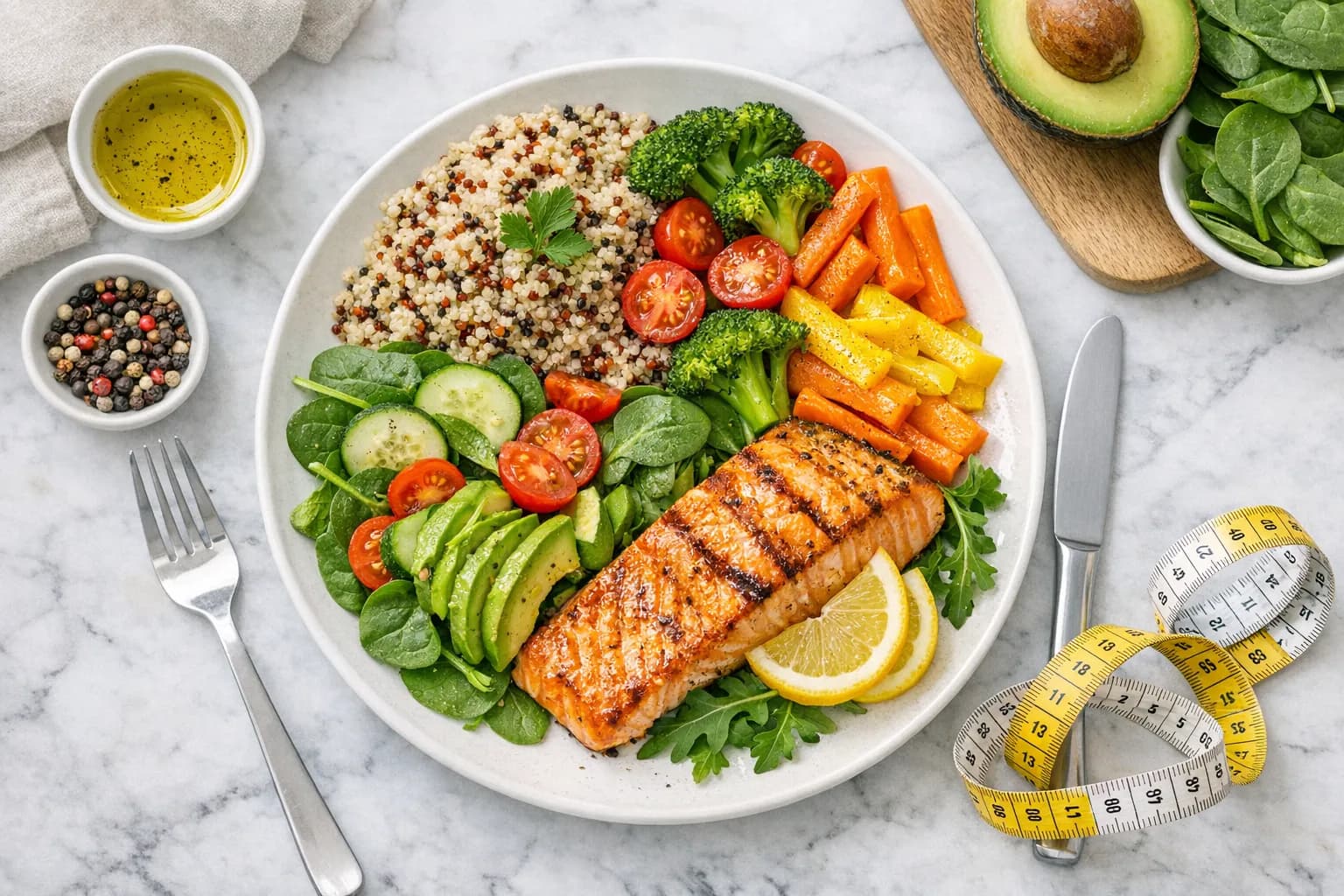
At every meal, build the plate around the protein first, then add vegetables, then the starch. This simple sequencing naturally produces balanced plates without counting every gram.
2. Volumetric Eating
Volumetric eating is the practice of choosing foods that take up a lot of space on your plate and in your stomach while containing relatively few calories. The concept was developed by nutrition researcher Barbara Rolls at Penn State University, and it is one of the most practical approaches to eating less without feeling like you are eating less.
The science behind it is simple: your stomach registers fullness based partly on volume, not just calories. A cup of grapes and a quarter cup of raisins contain roughly the same calories, but the grapes take up four times the space in your stomach. A bowl of broth-based soup and a slice of cheese pizza might have similar calorie counts, but the soup fills you up in a way the pizza does not.
High-volume, low-calorie foods to build meals around:
- Leafy greens (spinach, kale, arugula, romaine)
- Cruciferous vegetables (broccoli, cauliflower, Brussels sprouts, cabbage)
- Cucumbers, tomatoes, bell peppers, zucchini
- Berries and melon
- Broth-based soups
- Popcorn (air-popped, without butter)
- Egg whites
The practical application is to bulk up every meal with vegetables. Add spinach to your morning eggs. Put a massive side salad next to your lunch sandwich. Fill half your dinner plate with roasted vegetables before you even think about the protein and starch. You eat more food by volume, feel more satisfied, and consume fewer total calories.
3. Portion Control Through Structure
Counting calories works mathematically but fails practically for most people. It is tedious, it makes eating feel like accounting, and it creates an unhealthy relationship with food over time. A better approach is to use your meal plan as a portion control system.
When you plan a meal and measure out the ingredients during prep, the portion is set. You are not deciding how much pasta to put on your plate when you are hungry. You already measured four ounces of dry pasta per person when you were clearheaded on Sunday. The same goes for rice, oils, nuts, cheese, and other calorie-dense foods that are healthy in moderate amounts but easy to overeat.
Practical portion guidelines without a food scale:
- Protein: a portion about the size and thickness of your palm (roughly 4-6 oz)
- Grains and starches: a portion the size of your cupped hand (roughly 1/2 to 3/4 cup cooked)
- Fats (oil, nuts, cheese): a portion the size of your thumb (roughly 1-2 tablespoons)
- Vegetables: fill the rest of the plate, no limit needed
Tip
When you cook with oil, measure it rather than pouring freely. A "drizzle" of olive oil can easily be 3-4 tablespoons, which adds 350-500 calories to a dish without adding any volume or satiety. One tablespoon is usually plenty for sauteing vegetables or coating a pan.
The 7-Day Weight Loss Meal Plan (1,500-1,800 Calories/Day)
This plan is designed for a moderate caloric deficit that supports steady weight loss of about one to two pounds per week for most adults. Each day provides approximately 1,500 to 1,800 calories with 100-130 grams of protein. If you are larger, more active, or male, you may need to scale portions up slightly. If you are smaller or less active, scale down the starch portions.
| Day | Breakfast | Lunch | Dinner |
|---|---|---|---|
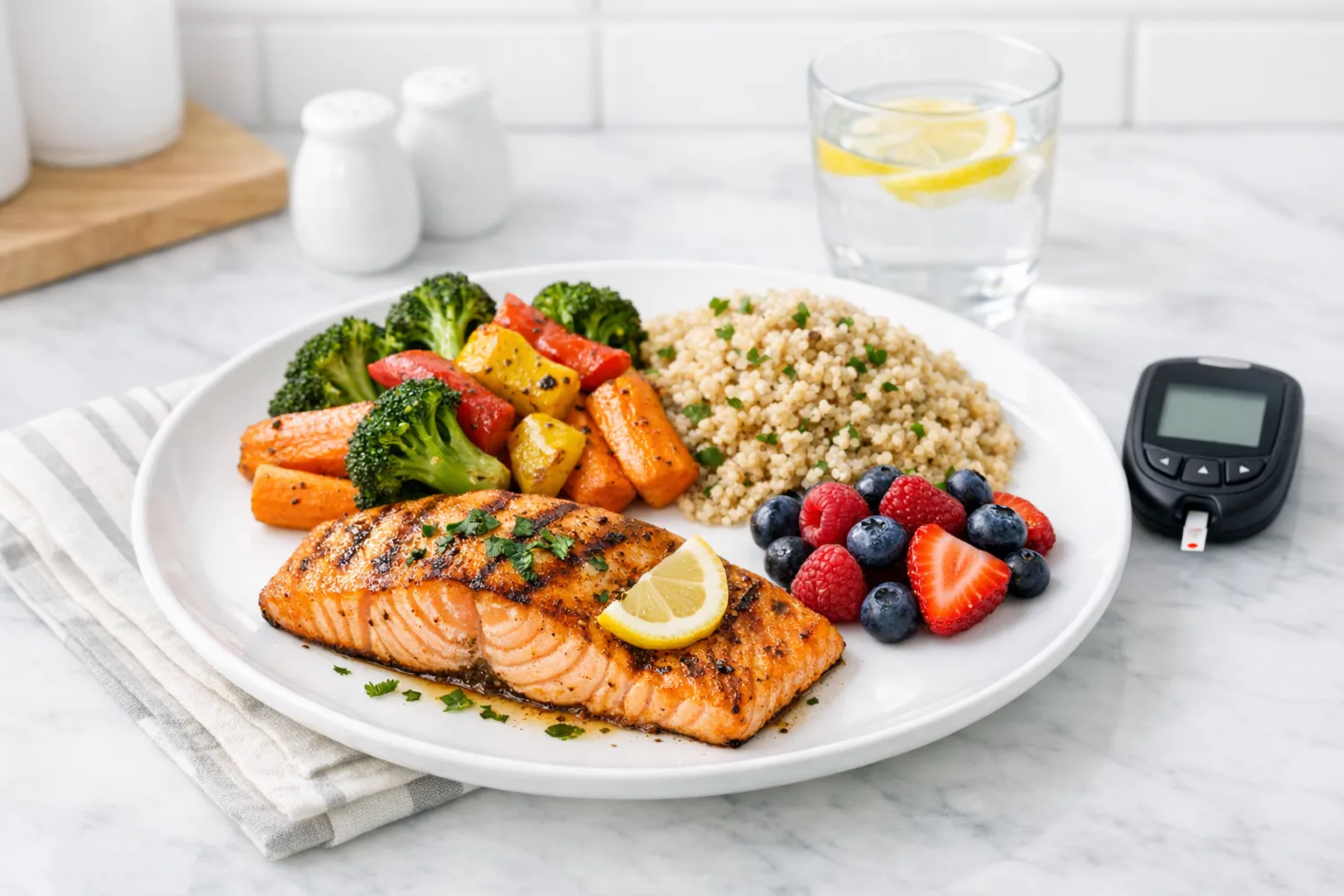
| Monday | Greek yogurt (1 cup) with 1/2 cup berries, 1 tbsp chia seeds, and a drizzle of honey | Large spinach salad with grilled chicken breast, cherry tomatoes, cucumber, 1/4 avocado, and lemon vinaigrette | Baked salmon (5 oz) with roasted broccoli and 1/2 cup quinoa |
| Tuesday | Two-egg omelet with spinach, mushrooms, and feta cheese, plus one slice whole grain toast | Turkey and hummus lettuce wraps with carrot sticks and a small apple | Chicken stir-fry with bell peppers, snap peas, and broccoli over 1/2 cup brown rice |
| Wednesday | Overnight oats: 1/2 cup oats, 1 cup almond milk, 1 scoop protein powder, topped with sliced banana | Lentil soup (2 cups) with a side of mixed greens and a hard-boiled egg | Ground turkey stuffed bell peppers with black beans, corn, and a sprinkle of cheese |
| Thursday | Cottage cheese (1 cup) with sliced peaches and a handful of almonds | Leftover stuffed pepper filling over a large bed of romaine with salsa dressing | Shrimp and zucchini noodles with garlic, cherry tomatoes, and olive oil |
| Friday | Protein smoothie: 1 cup spinach, 1 banana, 1 scoop protein powder, 1 tbsp peanut butter, almond milk | Chicken breast over mixed greens with chickpeas, cucumber, red onion, and tahini dressing | Lean beef burger (no bun) with roasted sweet potato wedges and a large side salad |
| Saturday | Veggie scramble: 2 eggs plus 2 egg whites with tomatoes, onions, and peppers, served with 1/2 avocado | Tuna salad (made with Greek yogurt instead of mayo) in a whole wheat pita with mixed greens | Baked chicken thighs (skin removed) with roasted cauliflower and a small baked potato |
| Sunday | Whole grain pancakes (2 small) with fresh berries and a side of turkey sausage | Large vegetable soup with white beans, plus a slice of crusty whole grain bread | Grilled white fish with asparagus and 1/2 cup wild rice pilaf |
Monday
Tuesday
Wednesday
Thursday
Friday
Saturday
Sunday
How This Plan Keeps You Full
Every meal in this plan applies the three principles working together. Breakfast always includes a strong protein source (Greek yogurt, eggs, cottage cheese, or protein powder) to prevent the mid-morning crash that leads to snacking. Lunches are built on a base of vegetables with protein on top, creating volume and satiety. Dinners pair lean protein with a generous portion of cooked vegetables and a controlled portion of starch.
Notice that nothing is eliminated. There is bread, rice, pasta (in the form of the stuffed peppers), potatoes, cheese, and even pancakes. The difference is that these calorie-dense foods are portioned thoughtfully and surrounded by high-volume, nutrient-dense vegetables and lean proteins.
Meal Prep Strategies for Weight Loss Success
Sunday Prep Session (60 Minutes)
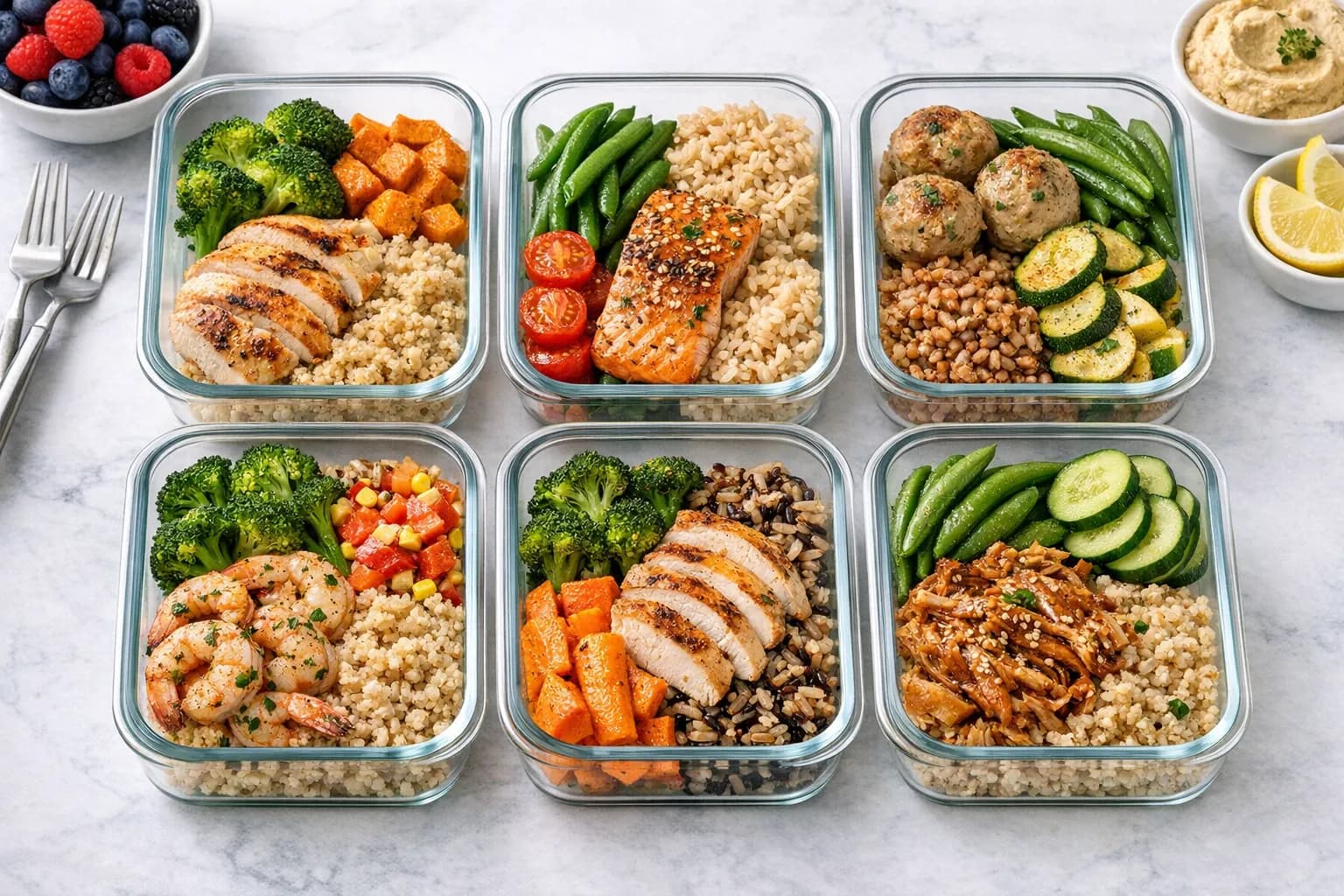
Prepping even a few components on the weekend makes it dramatically easier to stick with the plan during the week. Here is a focused prep session that covers most of the weekday meals.
-
Cook a batch of grains. Make quinoa and brown rice in bulk. Portion into containers at 1/2 cup servings. These pre-portioned servings remove the temptation to scoop "a little extra" onto your plate.
-
Grill or bake proteins. Cook 2-3 pounds of chicken breast, season simply with salt, pepper, and garlic. Slice or shred and store. This covers Monday's salad, Tuesday's stir-fry base, and Friday's lunch.
-
Prep vegetables. Wash and chop broccoli, bell peppers, snap peas, zucchini, and salad greens. Store in containers lined with paper towels to absorb moisture and keep them crisp.
-
Make overnight oats. Assemble Wednesday's breakfast in a jar so it is grab-and-go.
-
Hard-boil eggs. Cook six to eight eggs. They serve as snacks, salad additions, and quick breakfast options when the planned breakfast feels like too much effort.
The Snack Strategy
Snacking is where most weight loss plans quietly fall apart. Not because snacking is inherently bad, but because unplanned snacking adds 300-500 invisible calories per day. The solution is not to ban snacks but to plan them.
Keep these pre-portioned and ready to grab:
- A small container of mixed nuts (1 oz, roughly 160 calories)
- Sliced vegetables with 2 tablespoons of hummus
- A hard-boiled egg with a pinch of salt
- An apple with 1 tablespoon of almond butter
- A string cheese and a few whole grain crackers
When these are ready to eat in the fridge, they compete with and usually beat the alternative of rummaging through the pantry and emerging with half a bag of chips.
Common Mistakes That Stall Weight Loss
Underestimating Liquid Calories
Drinks are the most overlooked source of excess calories. A daily latte with whole milk adds roughly 200 calories. Two glasses of wine in the evening add 250-300. A smoothie made with generous portions of banana, peanut butter, and juice can easily hit 500-600 calories while feeling like a "healthy choice."
This does not mean you cannot have these things. It means they need to be accounted for. Switch to black coffee or use a splash of milk instead of a full latte. Measure ingredients in smoothies. Treat alcohol as a treat rather than a daily habit. These small adjustments can recover 200-500 calories per day without changing anything about your meals.
Eating Too Little
This sounds counterintuitive, but eating too few calories is one of the most common reasons weight loss stalls. When your body senses severe restriction, it responds by slowing metabolism, increasing hunger hormones, and conserving energy. You feel tired, irritable, and hungry all the time, which eventually leads to a binge that wipes out whatever deficit you created.
A moderate deficit of 300-500 calories below your maintenance level is the sweet spot. For most people, this means eating between 1,400 and 2,000 calories depending on size, age, and activity level. The 1,500-1,800 range in this plan works for the average adult pursuing gradual weight loss. If you are consistently exhausted or hungry on this plan, add another 200-300 calories through an extra serving of protein or starch. Slow, sustainable loss is always better than fast, unsustainable restriction.
Ignoring Cooking Fats
A tablespoon of olive oil has 120 calories. A tablespoon of butter has 100. When a recipe says "saute in oil," the amount you use matters significantly. Many home cooks pour oil by feel and use two to three times more than necessary.
For weight loss meal planning, measure your cooking fats. Use a tablespoon rather than a pour. Better yet, invest in a good nonstick pan or use cooking spray for tasks like scrambling eggs or sauteing vegetables where a heavy coating of oil is not necessary for the final dish to taste good.
Weekend Amnesia
Many people follow their meal plan diligently Monday through Friday and then abandon structure entirely on the weekend. Two unplanned days of eating can easily erase a week's caloric deficit. Saturday brunch, Sunday barbecue, a few extra drinks, some late-night snacking — these add up quickly.
The fix is not to meal plan your weekends with the same rigidity. It is to maintain awareness. Plan at least one meal each weekend day (usually dinner) and allow flexibility for the rest. Enjoy brunch, but skip the appetizer at dinner. Have a few drinks on Saturday night, but eat a lighter lunch that day. The goal is not perfection. It is preventing two unstructured days from undoing five structured ones.
Scaling Recipes for Your Calorie Target
The meal plan above targets 1,500-1,800 calories, but your specific needs may differ. If you find the portions too small, the adjustment is usually simple: increase the protein portion by an ounce or two, add an extra half cup of starch, or include one more planned snack. If the plan feels like too much food, reduce the starch portions first, since those are the easiest lever to adjust without affecting satiety.
When you need to scale a recipe up or down precisely, the Recipe Scaler lets you recalculate ingredient quantities for any number of servings. This is especially useful when adapting family recipes to single-serving or two-serving portions that align with your calorie targets.
Free Tool
Recipe Scaler
Instantly adjust any recipe's portions to match your calorie and serving goals.
Making Healthy Swaps Without Losing Flavor
One of the most effective weight loss strategies is making small ingredient substitutions that reduce calories without changing the character of a dish. These are not dramatic overhauls. They are minor tweaks that save 50-150 calories per serving.
- Greek yogurt instead of sour cream on baked potatoes, tacos, and chili (saves about 40 calories per 1/4 cup and adds protein)
- Zucchini noodles or spaghetti squash instead of half the pasta in any pasta dish (saves about 150 calories per serving)
- Cauliflower rice mixed with regular rice in stir-fries and bowls (halves the starch calories while maintaining texture)
- Lettuce wraps instead of tortillas for tacos and wraps (saves 100-150 calories per wrap)
- Mustard-based dressings instead of creamy dressings on salads (saves 80-100 calories per serving)
- Egg whites mixed with whole eggs for scrambles and omelets (two whole eggs plus two egg whites gives you the richness of whole eggs with extra protein and fewer calories)
For any substitution you are unsure about, the Ingredient Substitution Finder can suggest alternatives that work in specific recipes without compromising the result.
Building Long-Term Habits
The meal plan above gives you a starting point for one week. The real goal is to build a sustainable rotation of meals that you enjoy, that keep you in a moderate deficit, and that you can maintain without feeling like you are on a diet.
After your first week, keep the four or five meals you liked best and swap out the others. After a month, you will have 15 to 20 meals in your rotation, and planning becomes almost automatic. The cognitive load drops to nearly zero because you are choosing from a curated list of meals you already know you enjoy and that you know support your goals.
If you are new to meal planning entirely, the Meal Planning for Beginners Complete Guide covers the foundational process of building a weekly plan from scratch, from grocery shopping strategies to building a recipe rotation. It pairs well with this guide by providing the structural framework that makes calorie-conscious planning easier to sustain.
For working parents trying to balance weight loss with feeding a family, the Easy Meal Prep for Working Parents guide provides a 90-minute Sunday prep system that can be adapted to calorie-conscious cooking. Many of the strategies overlap: batch-cooking proteins, pre-portioning starches, and having vegetables prepped and ready to go.
Key Takeaway
Sustainable weight loss through meal planning comes down to three principles applied consistently: build every meal around a strong protein source (20-40 grams per meal) to stay full, use volumetric eating to fill your plate with high-volume, low-calorie vegetables and whole foods, and control portions through advance planning rather than in-the-moment willpower. A moderate deficit of 1,500-1,800 calories per day produces steady results without the deprivation that causes most diets to fail. The most important factor is not which specific foods you eat but whether you have a plan in place before hunger makes the decisions for you.
Ready to simplify your meal planning?
Join UseMealPlanner and get AI-generated recipes tailored to your preferences, dietary needs, and schedule.
Download the App